Split Log Rounds into Firewood with an Axe
- Hands on
- 120 min
- Season
- autumn
- Level
- moderate
- Makes
- roughly a wheelbarrow load of split firewood per hour of steady work
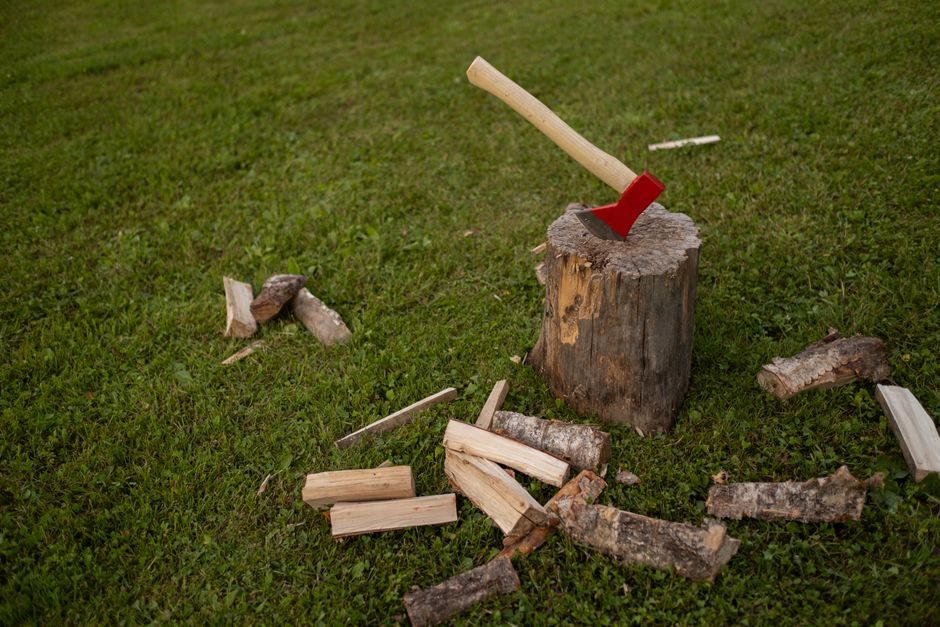
Once a trunk is down and cut into rounds — whether that's from a tree surgeon, a delivered load, or wood already sitting in the garden — splitting it into stove-sized pieces is the next job, and the one most people underestimate. It's repetitive, physical, and the way you do it matters more for your shins than your firewood. This covers splitting already-cut rounds with an axe and a chopping block, and when to switch to a wedge and sledgehammer instead of forcing it.
What you need
Step by step
-
Set the chopping block on firm, level ground, away from paths, washing lines or parked cars — splinters and chips travel further than you'd expect.
10 min -
Stand a round on the block so it sits flat; if it rocks, turn it to its most stable face before you swing.
5 min -
Stand with your feet wider than shoulder-width, to the side of the round rather than straddling it, so a missed strike travels past your leg, not into it.
5 min -
Raise the axe overhead and bring it down in one controlled stroke, aiming just off centre at a crack or the edge of a growth ring rather than dead centre.
30 min -
If the axe sticks without splitting the round, lift axe and round together and bring them both down hard on the block, rather than wrenching the axe free sideways.
10 min -
For a round that resists three strikes, or shows a visible knot, set the splitting wedge into any existing crack and drive it with the sledgehammer instead of forcing the axe.
15 min -
Work large rounds down in stages — halve, then quarter each half — rather than aiming to split a wide round in one piece.
20 min -
Clear split wood and chips from around the block every ten or so rounds so you're not swinging over debris underfoot.
10 min -
Barrow the split wood to where it will season, keeping the chopping area itself clear for the next batch.
15 min
Afterwards
Wipe the axe head dry, run an oiled rag over it to stop rust, and check the handle hasn't loosened in its socket. Sweep chips and bark off the chopping block, and barrow the split wood to a stack with airflow on all sides rather than leaving it in a heap, where pieces touching the ground won't dry.
Questions
Axe or maul — does it matter which?
A maul's heavier, wedge-shaped head drives through a round more easily than a thin-bladed felling axe, which is built for cutting across the grain, not splitting along it. A mid-weight splitting axe, around 2-2.5kg, covers most garden-sized rounds if it's the only one you own.
What if the wood won't split at all?
Very knotty rounds, or ones with a branch fork in them, often won't part along a line. Set those aside for the wedge and sledgehammer, or save them whole for a slow overnight fire rather than fighting them.
How soon can I burn what I've split?
Not yet. Splitting exposes the inner wood so it can dry, but most species still need six months to a year stacked under cover before the moisture content is low enough to burn cleanly.
Can I split wood that's still green?
Yes — green wood is often easier to split than fully seasoned wood, which can toughen and knot as it dries. Split soon after the rounds are cut, then let the split pieces season.